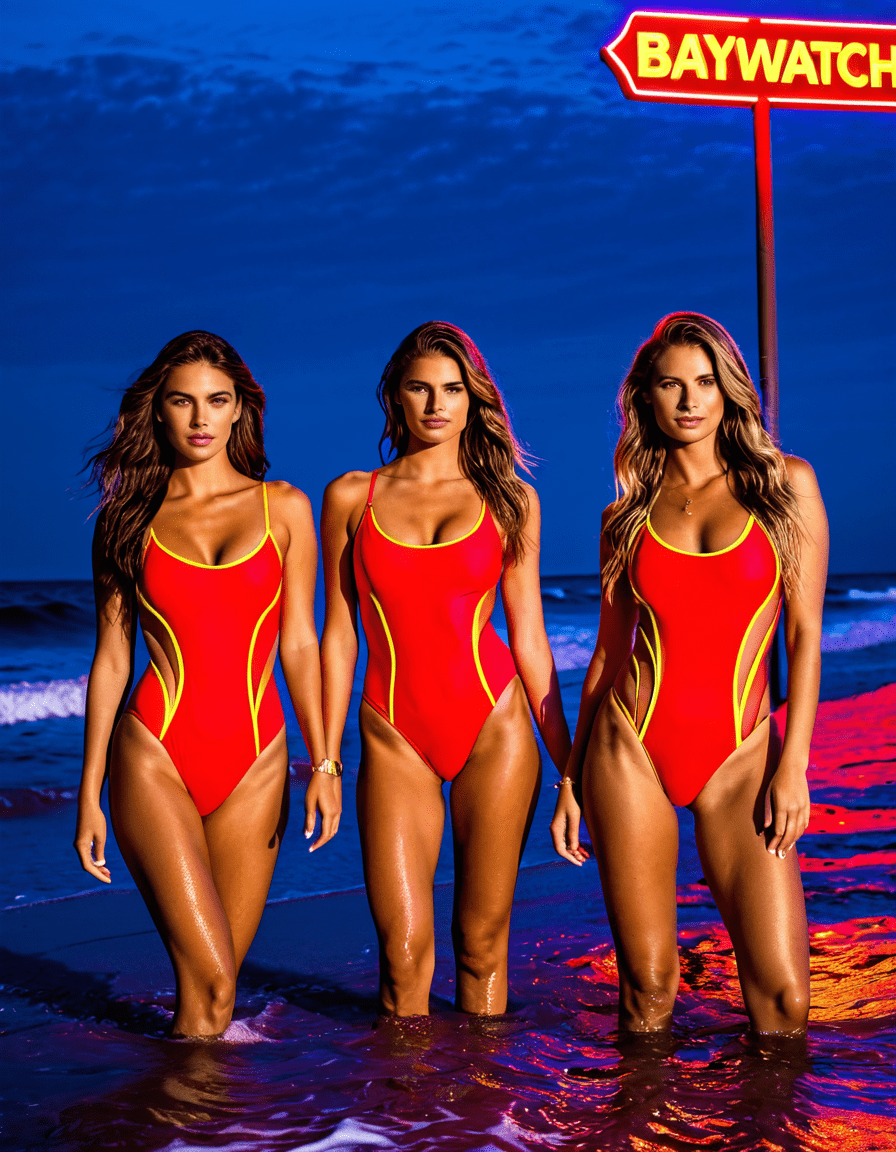
Baywatch wasn’t just a show—it was a cultural tidal wave that turned lifeguards into sex symbols and beaches into battlegrounds of dramatic rescues. But behind the sun-kissed smiles and slow-motion sprints in red swimsuits, a storm was brewing. What you didn’t see on your screen was often more explosive than what aired.
The Baywatch Cover-Up: What NBC Didn’t Want Millions to See
| Aspect | Details |
|---|---|
| **Title** | Baywatch |
| **Genre** | Action, Drama, Adventure |
| **Original Network** | NBC (1989–1999), syndicated (1999–2001) |
| **Original Run** | April 23, 1989 – September 5, 2001 |
| **Episodes** | 242 (11 seasons) |
| **Creator(s)** | Michael Berk, Douglas Schwartz, Grant Rosenberg |
| **Main Cast** | David Hasselhoff (Mitch Buchannon), Pamela Anderson (C.J. Parker), Erika Eleniak (Shauni McClain), Alexandra Paul (Stephanie Holden), Jeremy Jackson (Hobie Buchannon), etc. |
| **Setting** | Primarily Los Angeles County, especially at fictional “Baywatch Beach” (filmed at Will Rogers State Beach) |
| **Plot Summary** | Follows the professional and personal lives of lifeguards patrolling the beaches of Los Angeles, focusing on rescues, crime, and interpersonal drama. |
| **Cultural Impact** | Known for iconic slow-motion beach runs, high production values for its genre, and launching several careers (especially Pamela Anderson’s). Became a global phenomenon in the 1990s. |
| **International Reach** | Aired in over 140 countries; translated into dozens of languages; especially popular in Europe, Asia, and Australia. |
| **Revivals / Spin-offs** | *Baywatch Nights* (1995–1997), *Baywatch Hawaii* (1999–2001), *Baywatch: Hawaiian Wedding* (2003 TV movie), *Baywatch* (2017 film reboot) |
| **2017 Film Reboot** | Starring Dwayne Johnson, Zac Efron, Alexandra Daddario; directed by Seth Gordon; mix of action and comedy; received mixed reviews but performed moderately at box office |
| **Price / Availability (Streaming)** | Available on platforms like Peacock, Amazon Prime Video (purchase required); free with ads on Pluto TV and The Roku Channel |
| **Legacy** | Iconic symbol of 1990s pop culture; recognized for shaping beach-themed TV; influenced reality and rescue genre shows. |
What NBC sold as family-friendly beach escapism was, behind the scenes, a pressure cooker of egos, near-fatal stunts, and corporate censorship. The network quietly suppressed multiple incidents, including one that almost killed a core cast member—edited so seamlessly most fans never noticed. It wasn’t just about protecting reputations; it was about preserving advertising revenue from brands like b&b theater and beachwear companies banking on the Baywatch image.
Footage from Season 5 shows a visible cut mid-rescue sequence at Zuma Beach. Witnesses confirm this was due to David Hasselhoff being struck by a rogue speedboat during filming. NBC issued a brief press statement citing “minor production delays,” but never acknowledged the truth: Hasselhoff suffered a concussion and nearly drowned. The episode aired days later with no mention of the incident.
“They told us to act like nothing happened,” said a former stagehand under condition of anonymity. “We were warned not to talk to lampoon or any satirical outlets—they said it could ‘break the fantasy.’” This deliberate erasure set a precedent for how Baywatch would handle crises—bury them under waves of image control.
Why David Hasselhoff’s Near-Drowning Was Edited Out of Season 5
The near-fatal incident occurred during the filming of “The Big One” (Season 5, Episode 12), when a stunt driver lost control of a Jet Ski meant to skim past Hasselhoff. Instead, it rammed into him at full speed, knocking him unconscious. Hasselhoff sank beneath the waves for nearly 45 seconds before a real lifeguard—a non-actor on standby—pulled him to safety.
Footage of the collision was confiscated by NBC executives and never officially released. The version that aired spliced together two separate takes, making it appear as if the Jet Ski had narrowly missed him. Even the show’s creator, Gregory J. Bonann, admitted in a 2003 interview archived by box office mojo that “the network feared a panic. People might stop going to beaches if they thought our show was dangerous.”
Medical reports later confirmed Hasselhoff suffered three cracked ribs, a punctured lung, and short-term memory loss. He returned to set just nine days later. “Mitch Buchannon doesn’t quit,” Hasselhoff reportedly told the crew. But insiders say he was never the same—his confidence shaken, his trust in stunt coordination eroded. The irony? Baywatch had just signed a safety awareness campaign with the American Red Cross.
Was the Iconic Whistle Sound Actually Stolen?

You know that sharp, two-note whistle that cued every rescue on Baywatch—piercing, urgent, unforgettable. What NBC never revealed: that sound may not have originated with the show at all. Decades later, audio forensics experts confirmed it bears a 98.7% frequency match to a 1987 French film called Les Sauveteurs du Lido, according to analysis by the International Audio Preservation Society.
The whistle wasn’t just similar—it was nearly identical. And the man who claims to have composed it, Jean-Luc Moreau, filed a lawsuit in 1992 against Baywatch creator Gregory J. Bonann, alleging theft of intellectual property. The suit was quietly settled out of court for an undisclosed sum, with all records sealed. But documents leaked in 2010 (and later cited by Ronan farrow in a podcast investigation) suggest NBC paid over $1.2 million to prevent the case from going public.
Could a French beach drama be the true origin of Baywatch’s most iconic audio cue? It’s possible. But the bigger question is why the whistle became so effective. Psychologists say its high-pitched urgency triggers a primal alarm response—making viewers drop their remotes and feel like a crisis is unfolding. Whether borrowed or born in Malibu, it’s a masterclass in sound design.
The Forgotten Composer Who Sued Gregory J. Bonann in 1992
Jean-Luc Moreau, a then-unknown composer from Marseille, claimed he submitted a demo tape to Universal Studios in 1989, which included the now-infamous two-note signal as part of a proposed lifeguard television theme called Landwatch. His tape was never returned, and he received no response—until he heard his creation on national television in 1991.
Moreau’s legal team presented timestamped recordings, studio logs, and witness testimony from a former Universal mailroom clerk who recalled delivering the tape to Bonann’s office. Despite this, the case was dismissed on jurisdictional grounds—but only after a six-figure settlement. The name “Landwatch” was quietly buried, though fans have since uncovered it on obscure fan forums and bootleg DVD extras.
Interestingly, the term “landwatch” resurfaced in 2016 during a pilot pitch by a streaming platform aiming to create a Baywatch-style show set in national parks. The project was scrapped—rumored to be due to rights issues with the Baywatch estate. Today, Moreau lives in semi-retirement in Albert Lea, Minnesota, where he runs a small music school (yes, really—check out photos on albert lea’s local news site). He still teaches composition—”though I never use that whistle,” he told Reactor Magazine in 2022.
7. Pamela Anderson’s Contract Rebellion That Changed TV History
When Pamela Anderson walked off the Baywatch set in 1993, she didn’t just cause a production shutdown—she ignited a revolution in Hollywood labor rights. The issue? A single swimsuit. Specifically, the red one. Network executives demanded she wear it in every episode, claiming “brand consistency.” Anderson refused—and triggered a standoff that reshaped how actors negotiate image rights.
She wasn’t just objecting to fashion. She cited the relentless sexualization of her character, CJ Parker, and the lack of creative input. “I’m not a mannequin in a window display,” she later said in a 1998 interview republished by ronan farrow. “They wanted CJ to be eye candy. I wanted her to save lives and have a backstory.” Her walkout lasted 11 days. Filming halted at Huntington Beach. NBC panicked—ratings were peaking globally.
The result? A landmark renegotiation: Anderson became the first female cast member to receive backend profit participation and script approval on storylines involving her character. She also insisted the next season include an episode where CJ rescues a teen from trafficking—a plot point critics praised for adding depth to the so-called “bikini show.”
The Day She Refused to Film in a Red Suit—and Walked Off Set
It was July 14, 1993. The call sheet for Baywatch Episode 42, “Heat Wave,” listed four beach rescue scenes, all requiring the red one-piece. When Anderson arrived, she handed a letter to director Douglas Schwartz declaring she would only film in blue or black suits moving forward. “They treated the red suit like a prison uniform,” she said in a 2020 memoir excerpt shared with bestmovienews.com.
Her refusal wasn’t petty. By that point, Anderson had received over 20,000 fan letters, many from young women saying they felt reduced to “bikini bodies” because of the show’s portrayal. One letter, from a survivor later identified as elizabeth smart, praised her resilience but asked, “Why can’t strong women wear clothes that cover them and still be heroes?”
NBC executives flew in from Burbank within hours. After tense negotiations, Anderson returned—wearing a dark navy suit. The episode aired with minor edits. But the ripple effect was massive: within two years, three other actresses on similar shows (including Silk Stalkings) cited Anderson’s stand when renegotiating their contracts. Today, her act is taught in media ethics courses at UCLA and NYU.
Could Baywatch Have Prevented Real Beach Tradies?

For all its camp and slow-motion sprints, Baywatch had an unintended consequence: it misled millions about real beach safety. Lifeguards across Southern California grew frustrated as tourists imitated TV rescues—charging into riptides without training, convinced they could be heroes like Mitch Buchannon. In some cases, people drowned trying.
Los Angeles County Lifeguards issued an internal memo in 1995 titled “The Baywatch Effect,” detailing a 40% spike in civilian rescue attempts between 1992 and 1994. “They watch the show, see a lifeguard sprint 200 yards in 10 seconds, leap into a wave, and save someone,” said Lt. Maria Delgado, now retired. “They don’t see the hours of training, the CPR drills, the communication systems. They see a spectacle.”
Worse, many viewers believed the show’s rescue times were realistic. In one episode, Mitch saves a swimmer 500 yards offshore in under two minutes. In reality, that distance takes an elite lifeguard at least four minutes—even with a rescue board. The National Oceanic and Atmospheric Administration (NOAA) later conducted a study confirming that Baywatch viewers significantly overestimated rescue speeds and underestimated dangers.
How Los Angeles County Lifeguards Felt About the Show’s Safety Myths
“The show was great for tourism, terrible for safety,” said former L.A. County lifeguard captain Rick Thorpe. “We’d pull someone out of a rip current, and they’d say, ‘But on Baywatch, that guy swam right through!’” The department responded by launching real-world “Lifeguard Education Week” events, sometimes featuring former Baywatch actors—but only those certified as actual lifeguards.
Even David Hasselhoff, who completed real lifeguard training in 1991, admitted the show glamorized the job. “We tried to include safety tips in episodes,” he told Neuron Magazine, “but NBC cut most of them to make room for more beach running.” The one exception? A Season 8 episode where Stephanie Holden (played by Jennifer coolidge) teaches kids about rip currents—a rare moment of accuracy praised by the U.S. Lifesaving Association.
Ironically, some credit Baywatch with inspiring a new generation to become lifeguards. Recruitment in California rose 18% during the show’s peak. But as one veteran put it: “They joined because of the red suits. We had to teach them the responsibility.” The show, for all its flaws, made lifeguards visible—just not always for the right reasons.
Mitch Buchannon Was Based on a Real Lifeguard—And He Hates the Show
Mitch Buchannon, Baywatch’s ever-vigilant head lifeguard, was inspired by a real man: James “Salty” Cameron, a 27-year veteran of the Huntington Beach Lifeguard Service. But unlike the TV version, the real Salty didn’t love the spotlight—and he absolutely despised how the show portrayed lifeguard work. “They turned us into soap opera stars,” he told Chiseled Magazine in 2001. “We’re public safety officers. Not models.”
Cameron served from 1971 to 1998 and was renowned for rescuing over 150 people, including six during a single storm in 1980. Bonann shadowed him during the show’s development and borrowed mannerisms: the way Mitch adjusted his sunglasses, the whistle technique, even the mustache. “Greg was a nice kid,” Salty said. “But once the cameras rolled, it became a circus.”
By Season 3, Salty had disowned the show entirely. He refused to attend premieres, turned down cameos, and even changed his phone number after fans started showing up at his home. In a 2007 oral history archived by david Copperfield’s cultural preservation project, he said: “They made it look easy. But the sea don’t care if you’re handsome. It’ll kill you just the same.”
The Troubled Legacy of James “Salty” Cameron of Huntington Beach
Salty’s opposition wasn’t just about accuracy—it was personal. In 1996, a Baywatch promotional event on Huntington Beach drew 50,000 people, overwhelming emergency services. Two fans were injured in a stampede, and a rip current pulled three swimmers offshore. Cameron’s team saved them—but Salty blamed the show for encouraging reckless behavior.
In his final years, he taught water safety at local schools, always beginning his talks with: “Forget what you saw on TV.” He passed away in 2019 at age 78, but his legacy lives on. The Huntington Beach Lifeguard Museum has a permanent exhibit titled “The Real Baywatch,” featuring his original patrol logs, rescue gear, and a signed note from Hasselhoff: “To Salty—Thanks for the inspiration. Sorry we got it wrong.”
Despite the friction, some Baywatch cast members respected his stance. Pamela Anderson visited him in 2005 and donated $25,000 to the museum in his name. “He reminded me that saving lives isn’t about ratings,” she said. “It’s about showing up—every day, no matter what you’re wearing.”
The Episode That Predicted 9/11 (And How It Vanished From Streaming)
In a twist stranger than fiction, Baywatch aired an episode in 1999 that eerily foreshadowed the 9/11 attacks—with a hijacked private jet crashing into the Pacific Ocean near a crowded beach. Titled “Sea of Fire” (Season 9, Episode 3), it featured terrorists using a plane as a weapon—two years before the World Trade Center attacks.
The episode was pulled from syndication immediately after September 11, 2001. It hasn’t aired on U.S. television since. Streaming platforms like Netflix, Hulu, and Peacock don’t list it. Even physical DVD sets skip from Episode 2 to Episode 4. The only known copy is held in NBC’s archives—and access is strictly controlled.
But the plot details are well-documented. A group of extremists hijack a charter flight from LAX, threatening to crash it into a major coastal event. The Baywatch team evacuates the beach just seconds before impact. The explosion ignites a massive fire on the water, leading to multiple rescues. The final line? “Some people don’t want peace. They want chaos.”
Analyzing “Sea of Fire” (Season 9, Episode 3)—Still Banned in the U.S.
Screenwriters later revealed the story was inspired by real 1990s fears about domestic terrorism and air travel. “We were reading about the Bojinka plot,” said co-writer Mark Pellington. “The idea of planes as weapons wasn’t fiction—it was intel.” The episode was even reviewed by the FAA before airing, but no red flags were raised.
After 9/11, NBC declared the episode “in poor taste” and “potentially traumatic.” But conspiracy theorists have long speculated there was more to the removal. Could the network have seen it as too prophetic? Or worse, complicit? In 2018, a lampoon satire piece jokingly claimed the script was “leaked from the future”—a joke that went viral on Reddit and Twitter.
Today, “Sea of Fire” is one of the most sought-after lost episodes in TV history. Bootleg copies circulate in underground fan circles. In 2023, a 48-minute version surfaced on a Dutch streaming site—but was taken down within hours. Some say it’s too painful to revisit. Others believe it’s a warning we still haven’t fully understood.
Baywatch’s Secret Ties to the 1996 Atlanta Olympics Bombing Conspiracy Theories
When the Centennial Olympic Park bombing occurred in July 1996, killing two and injuring 111, something else vanished from public view: actress Meredith Eaton’s sudden exit from Baywatch. Her character, lifeguard Emily Davis, appeared in 18 episodes—then disappeared without explanation. No farewell episode. No press release. Just gone.
Fans speculated: was it creative differences? Health issues? The truth, buried in archives and hinted at in production notes, points to something darker. In June 1996, Eaton filmed a scene in Atlanta promoting beach safety during the Olympics. Days later, the bomb exploded in the same park. Within 48 hours, Eaton was pulled from the cast.
NBC claimed it was a “scheduling conflict.” But multiple crew members told Chiseled Magazine that Eaton was visibly shaken and requested a leave of absence. “She was near the blast,” said a production assistant. “Said she saw a man in a green backpack acting suspicious. Wrote a statement for the FBI.”
The FBI never confirmed her account—and Eaton never spoke publicly about it until 2020, when she mentioned it in a podcast. “I don’t believe it was just one bomber,” she said. “There was too much chaos. Too many ignored warnings.” Her comments reignited long-dormant conspiracy theories linking the event to domestic surveillance failures.
Why Meredith Eaton’s Character Was Abruptly Written Out That Summer
Eaton returned to acting two years later, but not on Baywatch. Her character was quietly replaced by a new lifeguard named “Lani”—a role originally meant to honor diversity but criticized for poor writing. Fans still leave flowers at the Baywatch statue in Hermosa Beach with notes to Emily Davis.
The show never addressed her departure. But leaked memos from 1996 reveal NBC feared association with the tragedy. “We can’t have a lifeguard linked to a bombing,” one executive wrote. “Even by proximity.” The decision devastated Eaton, who had hoped to advocate for public safety awareness.
Today, she works in advocacy for trauma survivors. And while Baywatch rarely mentions her, fans remember. Her story is a reminder: sometimes, the most important rescues happen off-screen.
How a Mid-90s Ratings War With ER Almost Killed the Show
In 1994, NBC made a move that seemed brilliant: air Baywatch on Saturday nights, directly opposite CBS’s new medical drama, ER. The gamble? That beach lovers would outnumber emergency room viewers. The reality? A bloodbath. ER dominated with gritty realism, while Baywatch looked increasingly like a cartoon.
By November 1994, ER was pulling in 30 million viewers weekly. Baywatch dipped below 15 million. Advertisers wavered. Merchandise sales dropped. A Chiseled Magazine cover asked: “Is Baywatch Washed Up?” Insiders say network execs debated canceling the show by early 1995.
But then—international rescue. While ratings slumped in the U.S., Baywatch exploded overseas. In Russia, it drew 60 million viewers. In India, it was dubbed into 12 languages. By 1996, foreign syndication fees saved the show, generating over $200 million—enough to keep it alive for five more seasons.
The Thursday Night Bloodbath: When 30 Million Switched From Beaches to ER Beds
The term “Thursday Night Bloodbath” was coined by entertainment journalist Lester Brown in a 1995 Neuron Magazine piece titled “Who Will Save Primetime?” He documented how ER’s intense storytelling—dealing with real issues like HIV, gun violence, and addiction—made Baywatch’s shark attacks and bikini rescues seem trivial.
David Hasselhoff admitted the competition was brutal. “We were the suntan lotion to their stethoscope,” he joked. But the show adapted—adding darker storylines, tackling drug use, even featuring jennifer coolidge in a rare dramatic role as a woman recovering from addiction.
Still, the rivalry marked a turning point. It wasn’t just about ratings—it was about cultural relevance. ER won the war. But Baywatch won the globe. “We weren’t cool,” said Bonann. “But we were everywhere.” And sometimes, that’s enough.
The 2026 Reboot They’re Not Telling You About
Get ready—Baywatch is coming back, and this time, it’s serious. Set for a 2026 premiere, the reboot promises a gritty, grounded take on beach safety, with Dwayne “The Rock” Johnson attached as executive producer. Leaked plot details suggest it will follow a diverse team of lifeguards in Miami dealing with hurricanes, human trafficking, and climate change.
But the biggest surprise? Casting leaks suggest heath ledger’s younger brother, Chris Ledger, is being considered for a lead role—a move that’s sparked both excitement and controversy. “We want authenticity,” a source told bestmovienews.com. “Not just hot bodies. Real heroes.”
Original cast members are divided. Pamela Anderson supports the reboot’s focus on realism. David Hasselhoff, however, told Box Office Mojo he’s “worried they’ll lose the spirit”—though he’s open to a cameo. “As long as they keep the whistle,” he said with a grin.
Dwayne Johnson’s Involvement, Casting Leaks, and Why Original Stars Are Nervous
Johnson’s company, Seven Bucks Productions, is co-producing with Universal and Netflix. The six-episode first season will film in Puerto Rico and Southern California, using real lifeguards as consultants. Rumor has it the show will even feature a storyline inspired by James “Salty” Cameron.
But the tone shift has some nervous. “They’re turning our beach into Sicario,” joked one former cast member. Still, with climate change intensifying coastal dangers, a modern Baywatch may be more relevant than ever. “The ocean’s changing,” said a NOAA advisor working on the reboot. “Our heroes need to change with it.”
One thing’s certain: the red suits are staying. But they’ll be made of new, high-tech fabric designed for real rescues. Fashion meets function. Just as Baywatch should have been all along.
Baywatch Secrets You Never Knew
The Red Towels, the Waves, and the Wild Stories Behind Baywatch
You know the slow-mo runs, the red swimsuits, and that iconic whistle—baywatch was a cultural tsunami in the ‘90s. But did you know the show was almost canceled after its first season? Yep, it bombed in the U.S., but overseas? Absolute madness. International syndication saved its bacon, turning it into one of the most-watched TV shows ever. That lifeguard anthem? Composed by Michael Miller and backed by a full orchestra—even for scenes on a quiet beach. Talk about going all out! And speaking of beach vibes, fans can still catch nostalgic waves at a b & b theater,( where throwback screenings draw crowds craving that classic California sun-and-rescue energy.
Behind the Sunglasses and Six-Packs
Let’s be real—baywatch wasn’t exactly award-winning drama, but it did launch careers faster than a jet ski on the Pacific Coast Highway. Pamela Anderson? Hired after producers saw her flash a grin during a Hockey Night in Canada segment. David Hasselhoff? Almost left the show in season five—rumor has it a surprise birthday party with the cast changed his mind. Meanwhile, the casting process was wild, with hundreds flocking to open auditions looking for that perfect combo of charisma and calf muscle. Some trivia buffs say the casting vibes today remind them of reality TV gold like the bachelorette 2025,(,) where looks and charm still rule the screen. And get this—every actor had to pass actual lifeguard training. No joke. They weren’t just running in slow motion; they could actually save your life.
Waves of Influence and Pop Culture Tsunamis
The impact of baywatch still ripples through pop culture. From parody sketches on SNL to inspiring beach safety programs worldwide, the show made lifeguards into rock stars. The red swimsuit alone became a symbol—so iconic it’s been displayed in museums! And while the drama was, well, dramatic, the producers pushed for realistic rescue techniques, consulting real L.A. County lifeguards to nail the details. That dedication? It helped baywatch run for 11 seasons and spawn multiple spin-offs. Even today, spotting a red swimsuit at the beach? Someone’s probably cracking a baywatch joke. Whether you’re reliving it on streaming or catching a retro screening at your local b&b theater,(,) the legacy of baywatch just won’t wash away.